The Nethermost Layer of Dinner
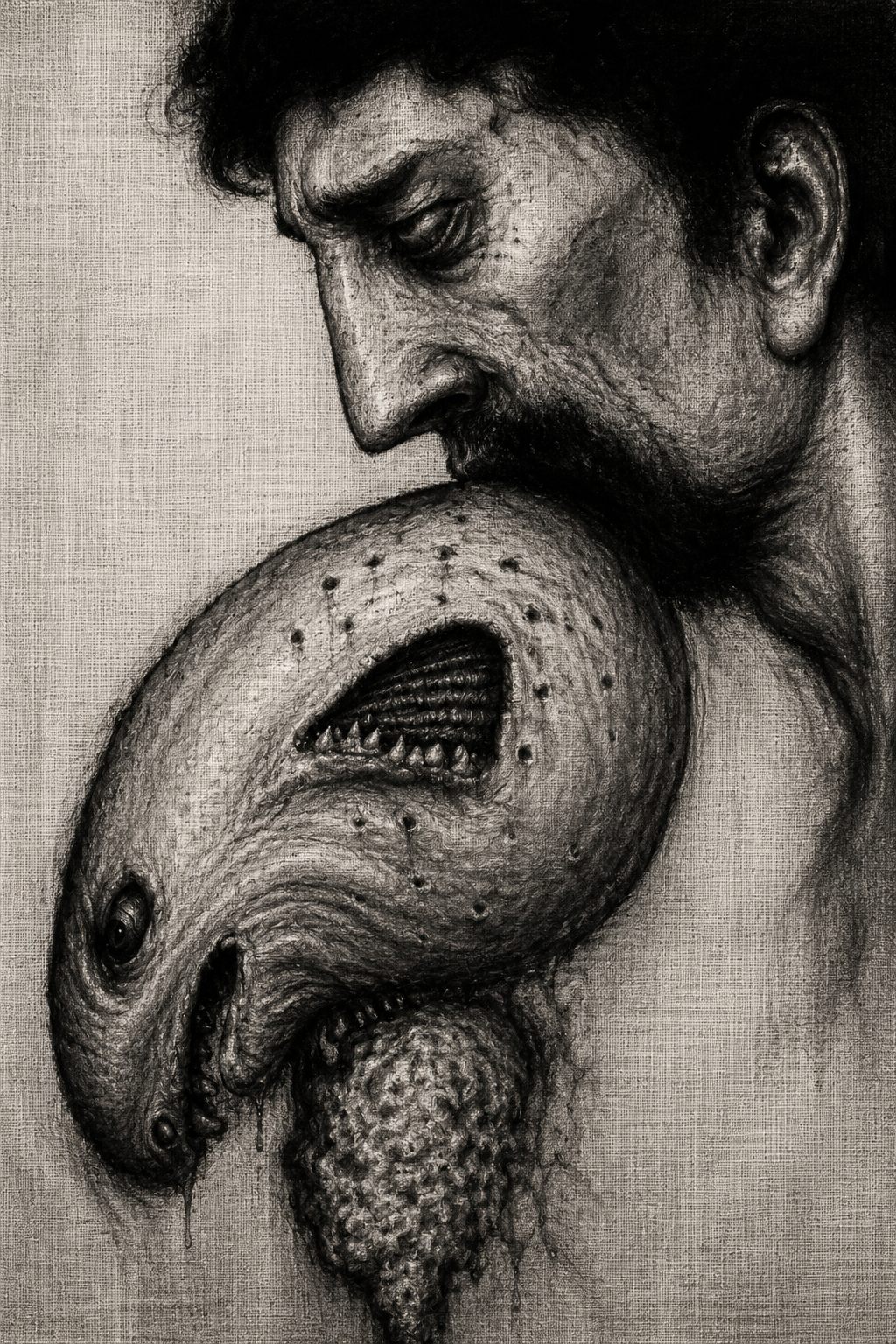
The rice stuck to the bottom of a cheap cooker is not tragedy. Not proper tragedy. Sophocles did not sit in a rented South Calcutta room with a scratched aluminum bowl, a sweating neck, a failing fan, and a brown fossil layer of dinner forming quietly under his nose.
That is my department.
A rice cooker has a special talent. It can take something innocent, like rice, and turn the last spoonful into archaeology. You scrape it with a spoon and hear that small dry sound, as if civilization itself has gone brittle. Outside, some scooter coughs. Somewhere a pressure cooker screams. A crow makes a remark from a cable wire, because crows in Calcutta are not birds. They are unpaid municipal commentators.
Since about 2016, I have been wallowing in the Indian muck.
There is no more polite phrase that does not arrive wearing deodorant and lying through its teeth.
You may call it a “difficult phase” if you are talking to relatives who believe life is a school exam and bad marks can be corrected by discipline, prayer, and one more plate of luchi. You may call it “challenging circumstances” if you are applying for a grant. You may call it a “transition period” if you are in a LinkedIn mood, which means you are ruined but have found a blazer.
But the truth is muck.
Not cinematic muck. Not the grand sort where a man loses a company, gets betrayed, stands in the rain, lights a cigarette, and then punches fate in the jaw while background music behaves irresponsibly.
Mine is the budget version.
One room. One laptop. One rice cooker. One tea pan. One aging body. One brain that sometimes behaves like an old municipal water pump: coughing, rattling, threatening service, producing nothing drinkable.
There have been no ups and downs, really.
Only downs.
Then breakdowns.
Then a strange flatness after the breakdowns, like a pond after someone has thrown a brick into it and even the ripples have lost interest.
People like graphs. I know this because I spent enough of my life around data to know that human beings will tolerate almost any horror if you give it an axis label. Put misery on the Y-axis and time on the X-axis and suddenly it becomes a trajectory. It looks almost respectable. The line may be falling, but at least it is wearing shoes.
My line since 2016 is not a line.
It is a damp rope dropped into a drain.
There is no heroic volatility. No exciting market correction. No “after every fall comes a rise” nonsense sold by conference-hall saints with microphones, hair gel, and the moral depth of a paper plate.
There was flatness.
Then collapse.
Then flatness again, but lower.
This is how geology works, incidentally. Not every mountain erupts. Some landscapes simply sink. Sediment gathers. Pressure increases. Things are squeezed in the dark until they become coal, oil, or a middle-aged Bengali man staring at the ceiling fan and wondering whether even his expectations now need spectacles.
Expectation is a funny organ.
It is not in the medical textbooks, but it should be. Somewhere between the pancreas and the backside, because it secretes sweetness and produces shame. Young men have expectations the way young dogs have sudden enthusiasm, without permission and often in public. I had them too.
Career. Competence. Work. Dignity. Some money. Some companionship. Maybe the ordinary respectable furniture of a life: a proper desk, a proper chair, a proper reason to bathe before noon.
Now my expectations are at their nethermost.
Nethermost is a good word. It sounds like a place on a medieval map where dragons retire with joint pain. Below hope, below ambition, below optimism, below even anger, there is a damp little room where expectation sits in a lungi, scratching itself, saying, “Ki hobe? What will happen?”
Nothing will happen.
And the worst part is, the fellow may be right.
India does not help.
India is not a country for the exhausted honest man. India is a country for the flexible spine, the polished smile, the transferable conscience, the uncle network, the nephew ladder, the “manage kore nebo” priesthood of small frauds. If you cannot lie smoothly, if you cannot flatter power without feeling your tongue turn into a dead lizard, if you cannot stand in a queue and then quietly slip ahead through somebody’s cousin’s brother-in-law, India looks at you with mild irritation, like you are a ceiling fan making a clicking sound.
Nothing collapses dramatically here. That would be too honest.
Things thicken.
A form needs another form. A signature needs a witness. A witness needs tea. The tea needs sugar. The sugar has been stolen. The clerk is absent. The officer is in a meeting. The meeting is about efficiency. The result is that your life stands outside the door, sweating, holding a plastic file.
Since 2016, the public air itself has felt heavier. Not because everything before was wonderful. Please. We are Bengalis. Our nostalgia is also adulterated. Even our golden past arrives with dust, damp, and one relative explaining why you should have listened to him in 1994.
But something changed in the flavor of things.
The shamelessness became louder. The institutions became thinner. The slogans became fatter. The citizen became smaller. The man without money became less than small; he became transparent, like one of those plastic bags floating in a black monsoon drain, briefly inflated with air, then sucked under.
A society can rot without collapsing.
That is the clever trick.
A wall does not have to fall on your head to become dangerous. It can simply gather damp. The paint bubbles. A corner darkens. Someone says, “Nothing, nothing, just moisture.” Then one morning a chunk drops into your tea.
The British did not invent Indian corruption, but they certainly helped professionalize bureaucracy as an art of distance, stamp, file, delay, and superior nasal tone. Then we inherited the machine, painted it tricolor, added more gods, more ministers, more forms, more middlemen, more chairs with towels on them, and called it freedom.
Freedom, yes.
But often the freedom of the clerk to lose your file unless your file arrives with social lubricant.
And here I am: educated, aging, underemployed, overthinking, not exactly innocent, not exactly guilty, sitting inside the national latrine and trying to keep my sandals dry.
The body is where all politics finally comes to collect rent.
It is easy to say “economic stagnation” until the rice quantity becomes smaller. It is easy to say “mental health crisis” until you have not bathed for two days and the skin under your arms smells like a small dead animal who had philosophical questions. It is easy to say “lack of opportunity” until you realize your phone is silent not because you are above the market but because the market has walked past you like an old poster peeling from a wall.
The world keeps moving. It has no manners.
Somewhere a politician is promising development with the confidence of a man who has never waited for an unpaid invoice. Somewhere a young influencer is telling people to wake up at 5 a.m. and conquer the day, which is a useful plan if the day has not already conquered you by 4:47. Somewhere an app is asking for an update. Somewhere a bank is sending a message that begins with “Dear Customer,” which is always the start of a small financial ambush.
Meanwhile, in my room, the rice cooker clicks.
The click is important.
It means dinner has crossed from food into evidence.
Even depression becomes practical after a while. It stops being tragic and starts being administrative. Did I eat? Did I sleep? Did I answer that message? Did I pay that bill? Did I open the laptop, or did I simply stare at it like it was a tombstone with Wi-Fi?
This is the comedy, if there is any.
Not laughter comedy. More like the kind of comedy where a man slips on a banana peel, breaks his hip, and the banana peel sues him for defamation.
I do not anticipate great changes in my life. That is not pessimism anymore. It is weather reporting. Some people forecast rain by looking at clouds. I forecast disappointment by looking at the last ten years.
The barometer is reliable.
Pressure falling.
Humidity of humiliation: 91 percent.
Visibility: poor.
Chance of nonsense: extreme.
People call this cynicism because they prefer any accurate diagnosis to sound like a personality defect. But cynicism is often just memory with acidity. A man touches the hot stove once and learns heat. In India, the stove follows you from room to room, wearing a badge, asking for identification, and advising you to be positive.
Science, at least, has the decency to be cruel honestly.
Entropy does not smile and say everything happens for the best. Entropy says order requires energy, and if energy is not supplied, systems decay. That is all. No devotional soundtrack. No motivational talk. No neighborhood uncle claiming ancient India knew thermodynamics because some sage once sweated near a fire.
A life also needs energy to remain a life.
Not just calories.
Energy.
Social energy. Work energy. Civic energy. Erotic energy. The energy to imagine tomorrow as something other than today reheated badly. When that energy leaks for years, the self does not explode. It curdles. It becomes lumpy. It smells faintly of old milk and unpaid ambition.
And still the bladder wakes you.
This is the final insult and perhaps the final proof of biology’s vulgar sovereignty. Philosophy can collapse, politics can rot, career can vanish, hope can become a crushed mosquito on the wall, but the bladder remains a punctual civil servant.
It says, get up.
The bowel too, less polite and more federal in its authority, announces that whatever metaphysical despair may be in progress, evacuation is pending.
So I get up.
Not heroically.
No violins.
Just a half-bent man in a cheap room, shuffling toward the bathroom, holding the waistband of his shorts, feeling the knees complain, the stomach mutter, the skull throb, and somewhere in the distance of the mind a tiny clerk writes: still alive, kindly process tomorrow’s paperwork.
There is no lesson here.
There is only the nethermost.
And one rice grain stuck to my toe, following me across the floor like a loyal little creature with ambition.